
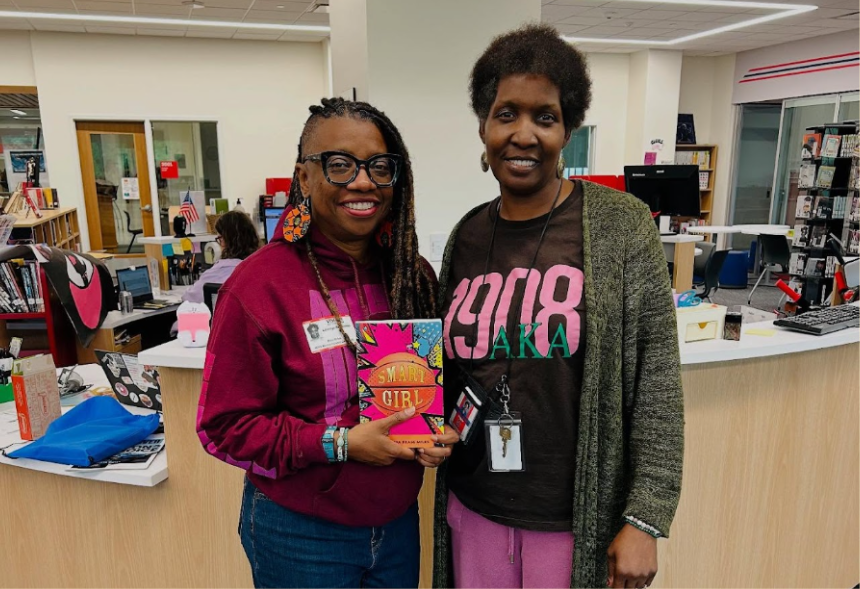
When meeting someone over a zoom call, participants are often ailed with glitches that blur personalities and hinder connection. However, across roughly 2,800 miles and spanning a three hour time difference, author and Titan Alumna La’Tonya Rease Miles’ Ph.D love for pop culture, hardworking spirit and inspiring confidence shone through to the Titans on the other end.
On Feb. 12, Miles visited the Minnie Howard library via zoom to explore her new memoir “Smart Girl: A First-Gen Origin Story” and discuss her career advocating and building programs for first-generation students, as a first-generation college student herself.
“Smart Girl” follows Miles as she grows up frequently moving schools and cities, with her love for books and knowledge accompanying her every place she lives. She spent portions of her childhood and her last three years of high school in Alexandria, attending both Naomi Brooks Elementary School (formerly Matthew Maury Elementary) and Alexandria City High School (formerly T.C. Williams High School). Miles also attended three different colleges for her undergraduate degree, each with very different experiences.
The book follows Miles’ educational journey and how hardships, including experiencing racism and self doubt, along with her overdue recognition of herself as a first-generation college student lead her to become the trailblazing leader she has become today in first-generation studies and awareness.
First-generation, or “first-gen” as it is often referred to, describes a student whose parents did not complete a four year undergraduate college degree.
Despite her successful career in the field, Miles wasn’t aware of her status as a first-gen student for many years. “I went through my entire educational career not knowing I was first-gen,” said Miles. “When I found out I was, I already had a PhD. It just wasn’t language that was being used.”
At her first college, the University of North Carolina at Chapel Hill, Miles experienced what she called a “culture shock,” a term she didn’t know at the time but related to her experience when she learned it later on in life. Miles found herself struggling with seemingly basic and fundamental college tasks, dropping a class or picking a major, largely because she had no one in her family to teach her.
Looking back, Miles recognizes that these hardships were related to her identity as a first-gen student and how this put her at a disadvantage compared to other students. However, at the time she blamed her struggles on herself.
“I was attributing my experiences to other parts of my identity,” said Miles. “I think I was internalizing, like maybe there’s something wrong with me or maybe my family is crazy.”
At UNC, along with academic struggles, Miles experienced racism from the other students which added to her feelings of isolation. “I felt like an outsider, even among other black students,” said Miles. “That’s what propelled me to look for another school.”
Miles eventually transferred to Howard University, a historically black institution in Washington D.C., however, she still felt it wasn’t the right fit.
“I left Chapel Hill, it was like, ‘oh, maybe I should not be at a predominantly white institution, maybe I should go to an HBCU,’” said Miles. “Then I go to a historically black institution, like, ‘oh, still having problems.’”
Eventually, Miles ended up at the University of Maryland where she found support and was able to prosper, however, looking back, she wishes she knew about the first-gen community sooner.
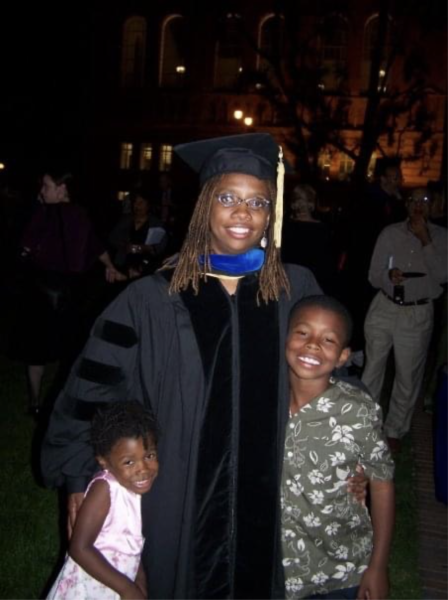
“I think the beauty of when you have a shared identity is then you connect with other people who are going through it as well,” said Miles. “You’re like, ‘oh wow. It’s not just me.’ And then you have resources.”
Miles believes that knowing about her identity at the time could have made a big difference in her college experience. “I suspect I would have probably found my place a lot sooner and not felt as alone,” she said.
In one of the opening scenes in “Smart Girl,” Miles recalls the moment a grad student told her she was first-gen, and how this epiphany set her on the path to the success she has today. “It’s kind of like in “Star Wars” when you realize this is my purpose,” said Miles. “My role as Luke Skywalker is to save the universe.”
Consideration of her younger self has become one of Miles’ driving motivations throughout her career helping first-gen students. “I wanted to give back,” said Miles. “[So I] created programs and classes and events that I really could have benefited from.”
Miles has established first-gen programs at UCLA and Loyola Marymount University, as well as programs at high school levels.
Miles has also co-founded the non-profit organization My Tribe Media which works to advocate for and change views on non-traditional learners, including first-gen students. Furthermore, she is the co-founder of various online first-gen advocacy groups, including a Facebook group with more than 7,000 members and is the co-founder of ADEii Health, an organization that works to increase access to behavioral health programs in small-scale settings.
Through all of her work, one of Miles’ main goals is to change the narratives surrounding first-gen students.
“What we want to do is have students and their families have a positive association with the identity,” said Miles. “For a long time, the belief was these are poor students who are underprepared for college and their parents and families don’t know things. I really want to challenge that. I think for the most part, parents and families are doing the best they can with the information that they have.”
Through her work, Miles emphasizes her belief that first-gen is a strength rather than a weakness. “Let’s think about what it means to be a pioneer, to be an innovator,” said Miles. “We actually want to celebrate it.”
However, despite Miles’ stellar career, she for a long time felt hesitant to write her own story. She said she often considered herself as someone who champions others but whose own story is not worth telling.
“I think it’s pretty common for most people, especially young people, to think ‘I can’t make a difference,’” said Miles. “We have to remember [the people we look up to] aren’t born with crowns on their head. They were most likely…ordinary people until they made extraordinary work over time.”
It wasn’t until someone else brought it up from a new perspective that Miles began to consider the possibility of writing her memoir.
“It wasn’t until maybe 34 years ago when someone said, ‘hey, why don’t you tell the story that you needed?’” said Miles. “I think I think we all sometimes need that little push. We need that nudge. We need that, the Yoda in our lives.”
Realizing that their story is important is just one of the many things Miles hopes readers get out of the book, along with the importance of self knowledge.
“One of the messages I like to leave with students is really the true value in knowing, what are you good at? And what do you love? And how can you turn that thing into…a career,” said Miles.
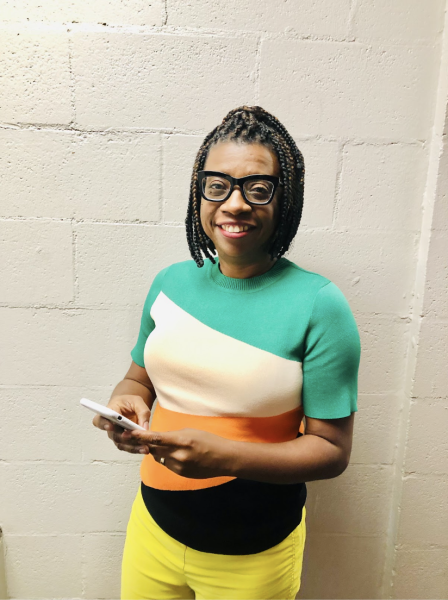
While Miles emphasizes the book’s relatability to all first-gen students, she hopes the story will specifically bring attention to the experiences of African American first-gen students.
“Oddly, [African American first-gen students] are kind of underrepresented when it comes to this experience,” said Miles. “I think people overly associate first-gen with immigrants, particularly folks who identify as Latinx. And of course, that’s a significant population, however, I think black students need to have some representation and some heroes.”
While Miles hopes to highlight black first-gen experiences, she still believes the memoir is universal in its lessons and can see anybody, no matter their identity as first-gen or not, connecting with the central themes.
“The book is really about celebrating,” said Miles. “You’re celebrating your passion and celebrating the things that you love and trusting that those are the things that will get you through at the end of the day.”
Celebrating her passions and interests is certainly something Miles does throughout her book and in her career. Whether its references to “Star Wars” or her favorite basketball players, Miles’ love for pop culture is littered throughout her book, her website and across the presentation she gave to students during her virtual visit.
Following Miles’ virtual visit, students reflected on the presentation. “I took away the importance of not giving up,” said sophomore Nour Yassein. Yassein also said she is looking forward to reading the book, as Miles provided each student a free copy during the event.
Minnie Howard Librarian LaGina Gross, who hosted the event, said she felt the book could be beneficial for both first-gen and non-first-gen students. “I think students who are not first-gen can get that information about courage, survival and moving on,” said Gross. “You still can get strength from people, even though you can’t relate to that experience… I think we learn from everybody.”
For a parting lesson, Miles said she hopes that students are aware that there is always a choice, and that even if you don’t feel like college is the place for you, you can find your space.
“It’s really about knowing that there’s a range of colleges and universities, [and] a range of experiences,” said Miles. “You don’t have to feel stuck. Maybe that’s the message, you don’t have to feel stuck.”


Iyone Scales • Mar 5, 2026 at 12:41 pm
Latonya
I’m so proud of your accomplishments and how you are working with others to find their position in this world of confusions. You are a blessing from God! Keep up the great work you are doing!
Love
Iyone Scales