


According to the 2024 National Assessment of Educational Progress, an exam that covers 24,300 students over 1,500 schools, reading levels among public school students are at an all-time low. The NAEP has been administered since 1969 by the National Center For Educational Statistics, under the U.S. Department Of Education. Since the NAEP’s founding, high school reading scores have remained relatively consistent. However, in 2015, they began their gradual decline.
This drop in scores has stoked fear among parents, teachers and communities due to reading’s vital effects on children and teens. “It’s the basis of everything,” said Alexandria City High School’s testing coordinator Molly Freitag. Freitag went on to mention how a lack of literacy skills can damage individuals in ways outside of a schooling environment. “[Not only] students that want to go to college have to be able to read well, you need it for every single thing. You have to be able to read documents…if you’re signing a document that you don’t understand you’re still liable for that document.”
However, lower national reading scores may not accurately reflect the reading frequency of students at ACHS. “I know the reading scores are going down, but you have to remember: that’s a test, so that’s not really about how many people are reading,” said ACHS librarian Laurel Taylor. Taylor also said that she believes that the rise in teens using social media may be increasing the number of students reading. While this claim may come as a surprise to many, there is a possibility that teens are seeing reading related content in their feeds. On TikTok, the second most used social media platform by teens, there have been 68.6 million posts using the “BookTok” hashtag.
Taylor also works as an adjunct professor at George Mason University. She said that she often tells her students about reading’s positive psychological effects on young people. “The research that I’ve read and shared with my students consistently shows that reading makes people more empathetic,” she said. “When you experience other people’s lives through books, you also start to think about the complexity of other people’s lives around you.”
In 2023, The University of Cambridge conducted research on empathy in schools. In these studies, students were provided with video-based programs designed to increase empathy. After the programs were conducted, researchers noticed significant changes in student-teacher relations. According to a teacher who participated in the study, she had been able to resolve more issues within the classroom, with students saying that people in the classroom had become kinder. And because of reading’s effects on empathy in teens, there may be a direct correlation between reading and a positive and productive learning environment.
Freitag said that a lack of reading skills can also cause behavioral problems within the classroom.
“A lot of times, you see behavior issues that even will pop up because students want to avoid [reading],” she said. “So they might act out or put their head down or something like that because it’s much easier than looking, quote ‘stupid.’”
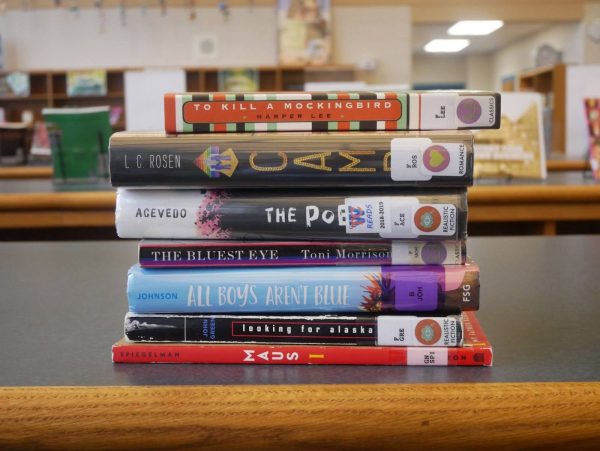
To ensure that reading is prioritized in schools, teachers emphasize the importance for the English Department to receive support from the school. And according to the chair of the English Department, Katherine Bentley, that is exactly what they have received. “We’ve always been allowed to order as many books as we want every year,” she said. “We’ve always been allowed to choose our books. And that has stayed consistent.”
Through this support, some students at ACHS have found a new joy in reading. In fact, senior Rilo Farmer said that his AP English Language and Composition class introduced him to his favorite book of all time, “Into the Wild” by Jon Krakauer.
ACHS senior Caleb Goodman said that he has “always had a love for reading,” but his English teachers have introduced him to new literature that he never would have read, such as stories by Shakespeare. “It gave me a new perspective,” he said.
While dropping reading scores may alarm many, ACHS’s emphasis of English literacy, along with the increasing number of students visiting the library to read, show how literacy remains a valued skill in ACHS– or, as Bentley described it, “one of Alexandria City’s greatest strengths.”


