



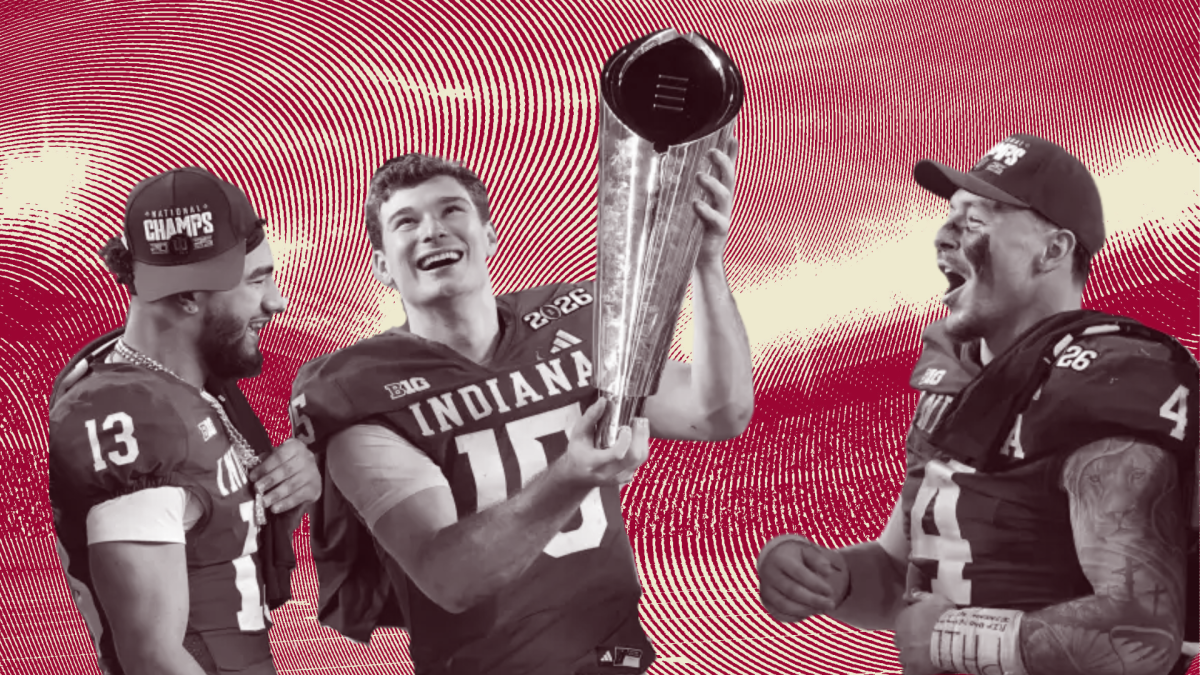
On Monday, Jan. 19, in the College Football National Championship game, the Indiana Hoosiers beat the Miami Hurricanes 27-21 in what some have called an “impossible” victory. As the Hoosiers reign in their first national championship win ever, along with an undefeated season, their place in collegiate football is now secured.
“This win is huge for our school as we have been labeled as a basketball school for the most part and finally are getting recognition that was doubted for most of the season,” said Indiana freshman Joseph McLaughlin. “We now have the ability to grow as a program after being the worst college football team in America for the last 137 years.”
With watch parties all over campus and many students watching the game from the assembly hall, the energy following the win was electric.
“This has and will continue to change my college experience as now I can say I’ve seen us win it all and have enjoyed the crazy atmosphere that can exist at this school and through the community.” said McLaughlin.
With the win altering campus as a whole, its roller coaster of emotions has also formed many unlikely friendships throughout the school.
“A lot of people now have something in common and are all celebrating together,” said McLaughlin. “Seeing their reactions and tears on TV showed what it really meant to take a group like us to the top.”
Amidst the excitement of Indiana’s victory, many wonder how an underdog like Indiana came to secure such a prestigious win.
“I’m sure you’ve read the stories about how minimal our roster strength was compared to everyone else in the playoffs but seeing the discipline and coaching ability was insane,” said McLaughlin.
The answer to that question lies in recent updates to the transfer portal regulations, which no longer limit how many times an athlete can transfer schools in their college career.
According to ACHS Athletic Director Felix Trammell, Indiana “took advantage” of the transfer portal for their win. “The new transfer portal rules allowed them to follow their coach to better destinations,” said Trammell.
When James Madison University Coach Curt Cignetti signed his Indiana contract ahead of the 2024 season, he brought 13 of his players with him, laying the stepping stones for Indiana’s 2025-26 season performance.
In particular, Hoosiers quarterback Fernando Mendoza formerly played for the University of California Berkeley for three seasons before entering the transfer portal and committing to Indiana in December of 2024 to join Cignetti. Later becoming the Hoosiers starting quarterback for the 2025-26 season, he paved the way for both their undefeated season and championship win.
The recent series of transfers highlights a new rank of college sports that launches even closer to professional careers, narrowing the parallels between professional and collegiate levels.
The December ESPN documentary Paid to Play: Understanding College Sports in 2025 describes the new transfer portal as giving collegiate level players “the freedom to bolt through free agency.”
Due to the new rules, players inch closer to the freedom of a professional career as they can seek new collegiate opportunities – much like a free agency in professional sports.
As seen in the 2025 season, the pattern of college sports have overall shifted from a “students first” model to a now high stakes marketplace where free agency trends dominate the college athletic experience, according to Paid to Play.
“The Name, Image and Likeness (NIL)/ transfer era highlights how college sports are evolving from amateurism to capitalism,” said sports journalist and ESPN reporter Jeremy Schaap during Paid to Play.
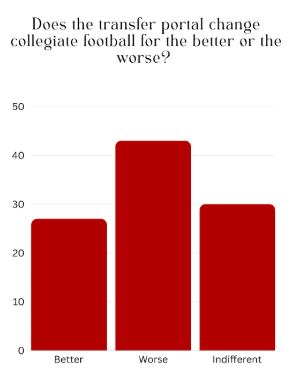
According to a Theogony survey, 43 percent of participants believe the transfer portal changes collegiate football for the worse, with 30 percent feeling indifferent and 27 percent feeling the new rules are for the better.
Alexandria City High School English teacher Matthew Zahn agrees with the majority sentiment, stating that although the opportunity for college athletes to get paid for their name, likeness and image, is beneficial, the transfer portal has overall changed college sports for the worse.
“It’s really hard to take advantage of a college education when you change schools every single year. There’s no continuity. You don’t have professors or mentors who know you,” said Zahn. “The things that are built into colleges that help make it successful, you’re missing out on all of them.”
For many college athletes, their likelihood of moving on to professional careers is slim, leaving them with an inconsistent college career and uncertainty for the future, according to Zahn.
Despite new questions and opinions arising as a result of this major shift in the college sports era, there is no doubt that Indiana’s hard work, versatility and utilization of the new transfer portal rules led to what some believe to be one of the most unlikely national title wins ever.
Now that Indiana has solidified their spot as fierce competitors in the NCAA, fans now await the next championship, where the transfer portal could produce another unpredictable victory.
“I expect us to continue to compete for the national championship every year,” said McLaughlin.