




When their phones light up with vague emails alerting them of “secure the building” or “evacuation” statuses due to fights and credible threats every month, students celebrate the interruption of instructional time. The majority of students don’t consider the possibility that they could be the next victim of a national statistic.
America’s history with gun violence is long and still being written. As the Columbine High school shooting came at the dawn of the 2000s, a spike in shootings (and national attention) set America up for its current patterns: gun violence in schools is becoming increasingly more frequent since 2010. As for ACHS, students are significantly desensitized.
Last December, following a series of violent altercations resulting in student and staff injuries, ACHS cancelled two days of in-person school leading up to winter break. Videos of a harmed, now retired, teacher on the hallway floor flooded social media.
That day showcased the true values of some of the ACHS student body; something to laugh at and time off school was the ultimate gift of the December season. To many people, this was nothing more than another day in ACPS.
Violence Trends
According to ACPS data, the notion of “just another day” proves to be true. In the first semester of the 2024-25 school year, ACPS averaged three incidents and approximately one call for APD each day, though the categories of “incidents” stretch across a multitude of definitions. Fourteen arrests occurred in the same period.
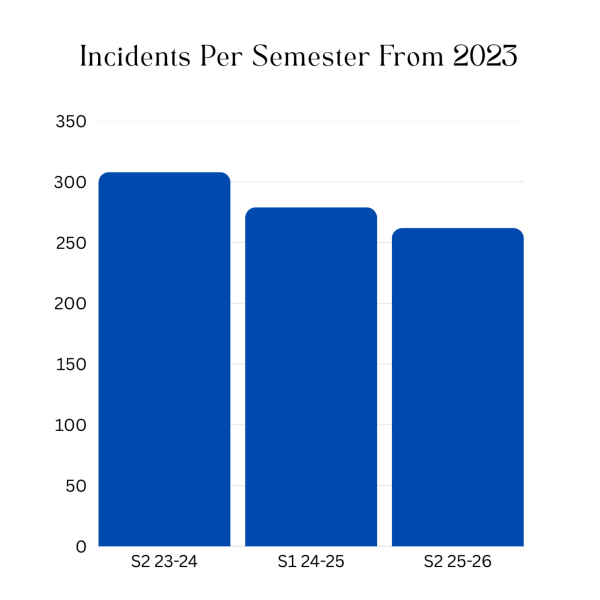
This pattern continued. The second semester of last year also averaged three incidents per day. However, calls for APD increased to a total of 124.
Out of all school levels, Alexandria middle schools exhibited the most calls for APD, arrests and incidents.
One of the most common threats facing ACHS are bomb threats. Over the course of last school year, 31 threats met the school. Some resulted in cancelled classes, lockdowns or simply a hold status.
When it comes to addressing the threats, the School Resource Officers (SRO’s) “take every threat seriously,” said SRO Al Davis.
The threats, according to the SROs, are evaluated by APD with a system that cannot be disclosed to the public.
As the security in the school completes their search, most students exhibit an opposite reaction to the threats. Some find it funny, some are the source and some enjoy the extended class period. Most don’t think much of it at all.
Senior Taha Ahmad stands against the threats, stating “School isn’t a place for [bomb] threats or fights.”
Things have improved slightly in recent years, but there remains a pattern of violence that ACPS has been experiencing for many years.
America’s Statistics
When comparing ACPS data with national averages, it is clear that ACPS is in the ranks of America’s statistics. According to the National Center for Education Statistics, from 2021-2022, 67% of public schools across the country reported having a violent incident. It’s clear that this isn’t something confined to Alexandria. Violence is engrained into America’s school systems. Students are prepared for school based violence in ACPS as early as pre-kindergarten. As the knowledge of threatening possibilities is taught at an early stage of life, students grow up with a normalized expectation of school violence, leaving kids perpetually unphased when events actually transpire. While they may be prepared for an incident, their anticipation is completely customary. They’re trained for it.

It must be noted that violent “incidents” are not isolated from school shootings. Often, the most common situation that leads to a shooting is an “escalation of dispute,” according to the K-12 School Shooting Database.

Since 2022, a significant spike in school shootings is apparent. In 2025, America faced 220 school shootings that resulted from a plethora of events.
With these facts, the countless other acts of violence occurring over this same time period, no matter how miniscule, should act as a warning sign.
ACPS’ Prevention Efforts
According to the SROs Al Davis and Eunice Addai, the current safety systems implemented in ACPS are well-prepared for keeping the students safe.
“I think one thing this school does very well is they tend to intervene relatively quickly,” said Davis.
“ACPS has taken steps that many school systems are also adopting—such as controlled building access, staff training, collaboration with local law enforcement, anonymous reporting tools and clearer discipline policies—to reduce opportunities for serious incidents and to intervene quickly when a concern is raised,” said Lee Conroy, Director of Safety and Security Services at ACPS.
ACPS has three types of security in both the middle schools and high schools — SROs, TriCorps security and ACPS appointed security.
The SROs, employed by the Alexandria Police Department, are a separate entity from the other security forces and are the only armed force in the school. Their role in the schools is implemented by a memorandum of understanding.
According to the SROs, the separation between them and the school creates some difficulties. SROs do not have access to cameras around the school to protect students’ privacy. Officer Addai said “If this place turns into a crime scene everyone has to leave. So not having access to certain things sets us back a little bit.”
The TriCorps security, identified by their black uniforms, are employed privately and contracted by the school. Unlike the SROs, they have the unique ability to take illegal substances from students without having to arrest them. Officer Eunice Addai summed it up, “What they can do, we cannot do.”
After its introduction as a pilot program in 2023, the Evolv weapon abatement system is present in both middle schools and ACHS. This mandatory system requires students to remove select items that set off the detector. These mandatory systems have often led to delays while entering the schools, often incorrectly flag innocent students and do not reliably locate weapons.
Many parents oppose the security measures, arguing they cause a disruption to the learning environment.
“The parents are getting upset when it takes so long [to go through the abatement systems], but those same parents are going to be the ones posting on social media that [we] didn’t protect [their] kids,” said Officer Addai. When looking at the national statistics, these measures may be the only thing that separates ACHS from becoming a ground where bullets can hit.
“We cannot measure incidents that were prevented before they occurred. This is a common challenge in all areas of safety and security across both the public and private sectors—success often lies in what does not happen,” said Conroy.
What Now?
“In 15 years it has not changed. It’s like the same school. The same behavior,” said Addai.
But it doesn’t have to be like this. Students do not need to accept the reality of a potentially violent environment and excuse it as “just their school,” because when the succession of political memes, dark humor and ignorance is rolled back, the true cracks in America’s system cannot be hidden.
And while ACHS is not currently in the history books as a victim of school shootings, students should not deny that possibility.
Ignoring the fear just to cope further incites desensitization among young students, who arguably need to be the most aware about these dangers.
The students of ACHS are better off understanding the weight of each situation than a gun’s shot becoming the only thing that breaks through their desensitization. A fight isn’t always just a fight, a threat isn’t always just a threat. In many cases, one act of violence is just a jumping point.
Do not let ACHS become the next jumping point.







Rozalia Finkelstein • Dec 11, 2025 at 1:24 pm
so proud of you guys for this article!!!